Squeeze the Toothpaste from the Bottom

After my father’s funeral I spoke to the family and friends who had gathered to show their respect and support.

“If my father was here today” I began “he would say that people are dying who have never died before”. It felt fitting to start with one of the many Ralphisms that have organically entered my everyday speech. I continued to summarise my father’s life (as I imagine most eulogies do) dividing his 77 years into milestone moments and then moved on to common themes that seemed to stretch across all life stages. His stories, the names of the characters in the stories and many of his sayings, seemed to flow out of me and I shared them with my audience. I felt then, as I still do, incredibly grateful for how much of himself my father had shared with me.

Fast forward to a week short of six years later and I was in the bathroom rushing to get ready. As I impatiently wrestled with an almost empty toothpaste tube, the familiar “squeeze the toothpaste from the bottom” popped into my head. I had forgotten that one in my speech and in my thoughts since, but there it was, as if there he was.

And here I am, on the eve of my 55th birthday lighting a yazheit candle for my father 6 years on.  

I light a candle to remember the life he led and to celebrate the life I had with him and the life I have left to live.

In the week between the toothpaste and now, I have noticed cars driving past with his initials on the plates and the time, almost every time I look, displays some combination of his birthdate.

I reread the words I wrote when he died and noticed for the first time that my description of him could be describing me. Even the dog lover adjective which was not true of me when my father was alive, is now applicable. And even my dog knows that when he gets a treat, he always will “have two, for luck” as my father used to say.

What I know absolutely is that with time the memories provide some kind of comfort. My written messages of condolence to others now includes traditional wishes for a long life plus a wish for ‘good memories to sustain you as your loved one lives on through you and yours’. What I know too is that when you are lucky enough to carry someone in your heart, you see them in your actions and hear them in your words.

That is my message here, triggered by toothpaste.

Black Holes & Never Again

Yesterday I had the privilege of testing my 22 year old son on some material for an Indigenous Astronomy course that he is doing. He is a very driven, busy young man, he lives away from home and knows a lot more about a lot of things than I do (or so I’m told). For those reasons and more it was a treat for me to “test” and interact with him like we did when we were both younger. As we moved from the brightness and speed of shining stars and lunar eclipses, from the heavens to their link with the land, from the Gadigal people to the holy site of Gummingurru, my son solidified his knowledge and I found the words I have been grasping for since early on Saturday morning 113 days ago.

For me, 2023 was a montage of exhilarating and life affirming moments interspersed among the usual humdrum and strife of life. I climbed and I flew and I manifested dreams long planned. I hope to share more of these soul gratifying experiences another time but today I will focus on just two.

The first involved a writer’s retreat in a mystery bay. It began with a step out of my comfort zone (which is how most adventures begin) a group of strangers and days of focus on an art skill I’ve long wanted to expand upon. There were possums and wallabies, unexpected connections and even a tic. I returned home determined to use what I had learnt and incorporate my writing practice into my daily rituals. On my teacher’s recommendation I carved out my special writing space and adorned it with a few “objets” to spark my creativity.

The second involved a visit to my daughter doing a university exchange programme in the Netherlands. The fact that I was visiting the place for the first time was secondary to our reunion and the easy, fun and free days we spent together exploring.

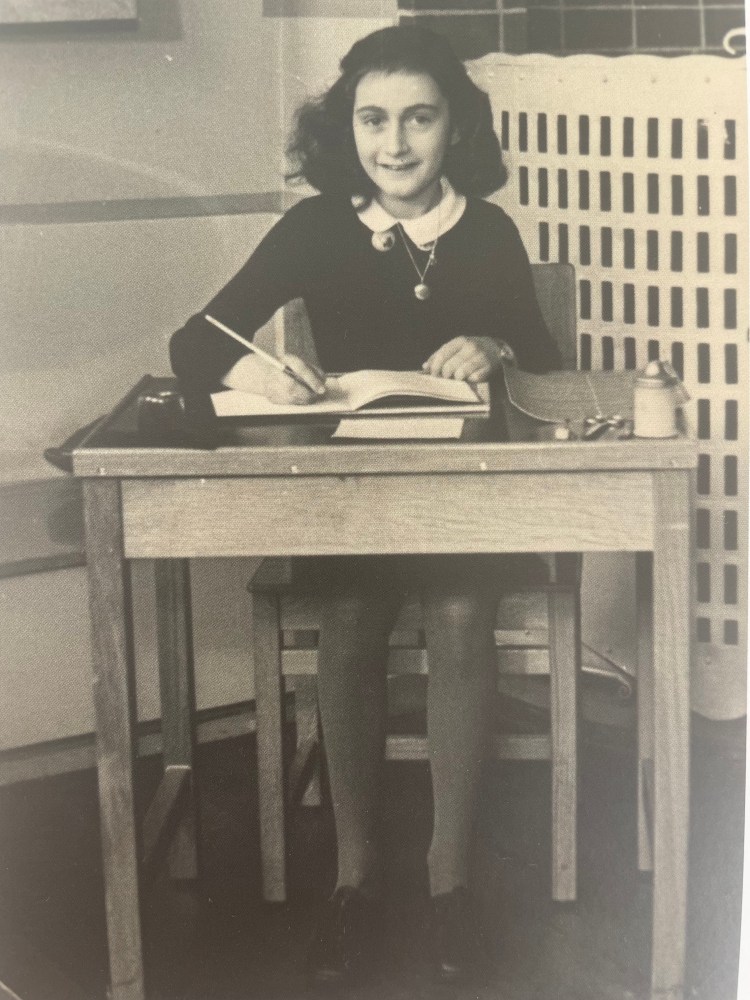
I did not expect to enjoy Amsterdam as much as I did or to feel its holocaust history so closely. I left Anne Frank house grateful to bear testament and with a postcard purchased from the museum shop. I chose a less publicized photo of Anne at her desk to take back to my writing altar and I promised myself I would keep writing just like a 14 year old child did without a safe space.

The past was with me almost as a present. I saw it in the shattered mirrors of memory of the Auschwitz victims, the bricks of named and unnamed Dutch who were lost and on the Stolpersteine (stumbling stones) that did their job well, reminding pedestrians of what had passed. When we visited the windmills by train, I wondered fleetingly if my view was anything like those transiting to Westerbork. I left the country feeling fortunate and fulfilled.

Then came October 7 and like a black hole, an astronomical phenomenon, suddenly there was darkness and the light had no energy to escape. It was now but felt again like 70 years ago.

I rerouted, hurried home, repressing the disappointment of not being able to reconnect under the Haifian sun and Anne and my writing were shelved.

THIS IS NOT ABOUT ME, IT IS NOT MY STORY.

And so I have spent what feels like a never ending day, obsessively scouring news channels, deleting friends and followers, posting and trying to “make sh*t happen” in any way that I can from a place far away. All the while Keren Peles and a host of other Hebrew language singers play on repeat.

THINK OF THE HOSTAGES, THE INJURED, THE FAMILIES

It took a random brush with indigenous astronomy and the passing of four full moons for me to recognise my role in the story and to put it into words.

Our connectedness explains why:

  • people I pass in my suburban streets have heads askew and eyes downcast like they are entering a shiva house.
  • faces are drawn and everyone is complaining of nightmares.
  • every answer to “how are you” is suffixed with “under the circumstances” or “in these mad times”

It explains why I cried at the sight of a red headed baby in the supermarket in Sydney.

Never before have I felt this connection as strongly, the connection between me and my people and my land, the darkness and the light.

Turns out that 18 years after emigration I am less African and Australian than I thought.

Just Jewish

In her bed

On Saturday afternoons I would go with my father to visit his parents. Sometimes my brother came with us. My dad went every week, even when we couldn’t go and my mom never did.

We entered their property through a side gate which my dad would unlatch, passed through the cactus filled garden (the wind was strong and often where they lived) and then using his own key my father would let us into their home.

We walked quietly past the bench at the front door where the telephone had its own table of honour and down the long, doored passage to their bedroom. The room was dark with curtains closed but as we entered both or either Granny Milly or Grandpa would invite us to join them up on the bed, under the heavy eiderdown. There was a not at all unpleasant but specific smell in the room. Thinking back now I can only guess that it was uncirculated air. The large windows behind the curtains were always shut too.

I was 18 years old when Granny Milly died and in all that time I never saw her leave her house. I don’t believe that she ever even ventured into her oasis like garden with the prickly succulents, chased the introverted tortoises or ate the fruit of the very generous loquat tree.

It has taken me 53 years to realise that like Rapunzel, my grandmother was locked in her castle, an undiagnosed mental health condition, her captor. “Hermit” was one of the most flattering names that my mother gave to her mother in law but whether it was agoraphobia, depression, anxiety or simply her default coping mechanism, something kept her hiding from the world.

I have been told that she wasn’t always shut off. I have faint memories of stories of a smartly dressed, clever woman with a wicked sense of humour. I can guess that fleeing from what she knew and escaping to a land far away, might have changed her. Or maybe it was after she moved from the old country to the new, when she transitioned from mistress of the house and the only shop for miles, to anonymous in the big city, that triggered her change?

Over the years I have noticed that when people struggle to understand other people, behaviours or events, they are quick to offer explanation and attribute reasons. This is especially true at times of mental health crises. “There were financial problems or marriage issues” can be gossip mongering or well –meaning, straw-grabbing attempts to make the unpalatable easier to digest.

Somehow with illnesses of the mind we think that we are qualified to diagnose and then remedy.  Yet somehow we just know that we cannot do that for a friend who receives a cancer diagnosis.

I will never know what exactly kept my grandmother inside for so long. Years later, the first overt sign of my father’s depression was his inability to get out from under the duvet, his modern day eiderdown. I have worked hard at times to resist and repel the magnetic attraction of my own bed.

If my grandmother were here today I would encourage her to get all of the professional psychological and medical help that she needed to move her. Perhaps then she would have been moved to tears watching her grandchildren perform on the stage or moved enough to reach the window and take in the view of the mountain and the sea.

#livingmybestlife

Have you noticed that suddenly everyone around you is living their best life?

Initially I was quite cynical (even scathing) about the latest hashtag to flood the social media world.

Once I saw it, I kept seeing it. It popped up in conversation and its overuse made it sound superficial and insincere. Until it happened to me too. I was #livingmybestlife.

Yes it most definitely helped that I was holidaying, that the heat on my skin came from the Mediterranean sun and that I had replaced treading on eggshells with treading water in the Tyrrhenian Sea.

The first summer break after the long Covid winter also added to the experience.

There was something more though and so here I am many, many weeks post-vacation, tan glow faded and yet still searching for the handbook on what my best life looks like is and how to live it going forward.

I’ve often said that “when you see it, you see it”. Hardly profound, but a reminder that once you see something you can’t ‘un’ see it. I suppose it’s like that with living (& loving) too. Once you’ve felt fully alive it isn’t enough to just exist. Throw midlife into this best life mix and you understand the urgency to live at full rather than flickering flame.

Lifetime

I was living my best life when I seized every second and saw time through reverent eyes. I made the most of all the moments and not just the moments I manage to capture in between. I took up every opportunity on offer, wasting little time in my bedroom and very few flicking through my phone.  It was as if the sands of the shores I was visiting had filled up a customised hourglass calibrated to match the finite end date of my travels. With my watch on one remote time zone and my phone on other, I was left to be where I was, entirely in the moment. And as being in the moment prevents one from being anywhere else, I stopped worrying (too much) about what might be and instead chose to be.

Lifelong

I lived my best life reconnecting with friends. There is something magical about spending time with people who remember or see you for who you are, especially when you yourself may have forgotten. After years of physical separation, I felt cocooned in their “unconditionality” and tickled by their humour. When I considered how dark our humour was (it is has been heavily shaded by life experiences) and how light our laughter made me feel, I could conclude with certainty that living my best life includes a guffaw that starts in the stomach and moves through the body to escape as a chortle (some strange sounding combination of a chuckle and a snort).

Lifeline

Moving my body has always helped me live better. Unbound by my own routines and the parameters of a reformer bed or treadmill, I entered the orbit and energy of the beachfront boardwalk before the heat of the day. I have been spent most of my life close to some path that hugs the seashore but the Atlantic Seaboard and Bondi to Bronte have seldom made me feel as alive as a trip to a short strip of a tiny Middle Eastern country. Unrelated to the foreign language background noise, I could feel the difference in the sound of the place and its pace. Everyone seemed to be running, even those who looked like they couldn’t or shouldn’t be. There were knee guards and back braces and a variety of running styles and speeds but on they went. Despite what held them together and through the dripping sweat, they kept going. I starting jogging slowly, ignoring the lower back ache that had made me the almost lone walker in the first place. Soon, I was moving to a running rhythm, exhilarated and pain free. Another reminder that sometimes it only takes a little warmth and flexibility to move you towards living your best life.

Camel Toes and Freedom

Suddenly it is that time of year again when we are inundated by eggs (chocolate and boiled) and a mixed bunch of bunnies, frogs, insects and wild animals.

It is the time when we once again are reminded about resilience and rebirth and the quest for inner freedom.

Through retold stories we remember a 40 year trek across the desert to a promised land but as we read we are charged ourselves to become part of the narrative. It is as if we ourselves are part of the exodus, travelling slowly, one foot in front of the other.

This year particularly I have been thinking about how the people moved from slavery to freedom, from incarceration to liberation. For once I am less interested in the logistics of the travail, the route they took or even their meal and pit stop planning but more in the personal transformation they undertook to reach “free” on a metaphorical compass.

We are showered with information about when and how the war ended or the wall fell or the rules were abolished and how freedom was claimed but a description of how free looks is less documented. It is possible I just haven’t searched for it yet.

Indulge me with two new stories this year.

First one is a true story –
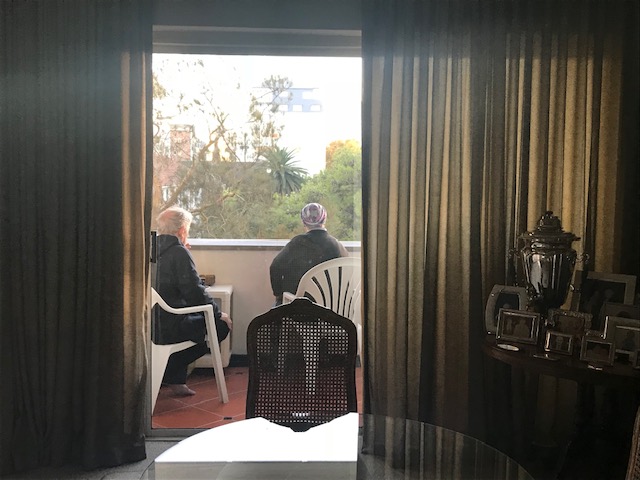
There is a special lady who has been employed by my parents for almost as long as Moses and his gang wandered in the desert. For 35 years she has shared in our family’s lives and we in hers. She has sat with us around tables as we celebrated and walked alongside us in the cemetery. When my father was alive they started each day together on the balcony with a cup of hot coffee and a cigarette and she was often referred to as his second wife. Her twin sons lived with us as boys and now with one grown and the other gone, a granddaughter has moved into our home and hearts. In 1994 South Africa became a democracy and the crushing arm of apartheid was lifted off her. When my father passed my mother invited her and her granddaughter to live with her. Still to this day, she chooses to live downstairs from my mom’s apartment in a room not dissimilar in size to a prison cell which she shares with her granddaughter. She uses the bathroom downstairs rather than using one of the three in the apartment. And despite years of insisting otherwise, she sometimes addresses my mother as Madam and refers to my late father as Master.

Second story I was told and probably is not so true –
Baby camel (to his mother) – “Why do I have two funny toes?”
Mother – “So you can walk easier across the desert sand, my son”
Baby camel – “Why do I have these very long eyelashes?”
Mother – “To protect your eyes from the desert sand storms, my son”
Baby camel – “Why do I have two humps on my back, mom?”
Mother – “To keep you hydrated when we have no water”
Baby camel (after some consideration) “So we have the toes for walking in the sand and the eyelashes for protection from the storms and the humps to store water in the desert so what in god’s name are we doing here in Taronga zoo?”

All the stories have made me wonder why the wandering took so long.
And why when the gates are opened do some still stay locked inside?
Fear? Lack of imagination? Paralysis?

A wise, generous of spirit, reformed friend who happened to find himself ‘inside’ for 3 years reminds us that “You can get out, call a lawyer” and even more poignantly that “not all prisons have walls and guards”.

It took 40 years to reach the Promised Land but they got there eventually.
Sometimes we need a gentle reminder of all we have (humps or eyelashes or toes) to be independent and free in the world.
“We must be free not because we claim freedom, but because we practice it” says Nobel Prize laureate William Faulkner.
Last year I brought famous quotations about freedom to the table, this year I want to see freedom, next year in Jerusalem or who knows?

From Generation to Generation

Part of my (most) daily ritual includes running on the treadmill at the local gym.

Lately the images that have flashed up on the overhead television screens have been of people trying to escape. Pictures of men, women and children fleeing war torn or water logged homes have flooded my vision. They are not limited to a particular age or gender or even nationality but their common denominator is what they are carrying. Forget about the emotional baggage, in this instance I refer literally to what they are holding with them as they leave. We witness shoppers, wheelie cases and back packs, basically modern updates of the hessian sacks and the wooden cart that Tevye pushed himself as he left his beloved Anatevka in Fiddler on the Roof.

In all the scary stories of people told to leave, we read, hear or see what they pack in their luggage of love.

Some of the most heart wrenching, gut churning photographs from Holocaust literature are of the piles of belongings that people valued, the carelessly strewn case contents which people ascribed meaning to.

It got me thinking about what I would take with me if I had to leave and about what I value most.

Aside from those I love, the only material items I could think of saving at first thought, was the necklace my father used to wear and the silver candlesticks that my parents had given me when I got married. Neither have any significant monetary value but both are steeped in sentimentality and therefore extremely precious.

Years ago when I packed up my life in another country and watched it crated into a huge container to make its journey across the sea, I ordered two blue metal trunks for which I kept the keys, to house my most valuable belongings. I am not sure what other people in my position used theirs for but my trunks were filled with home videos and photo albums.

While I still yearn to preserve the pictures of my past, both to remember what I might forget and to remember who I was, at times when I have forgotten, I’ve come to realise that making an escape with heavy albums will not be a practical option.

As I tried to get closer to my own answer of what to pack in an emergency (those who know me well know that I like to be organised for most eventualities), it took a visit to a spiritual sanctuary to guide me to my solution.

There is a prayer that is said apparently daily but also traditionally when a child celebrates their entry into adulthood. As I heard the haunting melody and harmonies I’d forgotten I knew, I closed my eyes to savour it fully without distraction.

L’dor Vador is a phrase that literally translates to from generation to generation.

Many years ago now, when I was starting off in the corporate world, I was drawn to a then emerging field called “Knowledge Management”. My superficial understanding was that it involved creating a system (company intranet was an example) to preserve the knowledge of an organisation. Even as staff changed, there was a record of their questions and answers or problems and solutions, to help facilitate transition and information sharing.  Organisational knowledge is thus preserved in a similar way a religion is sustained, by passing down spiritual knowledge and cultural traditions from generation to generation.

When we think about what we want to hand down, yes, the physical objects that have been passed down from parent to child to grandchild hold value and holding them and holding on to them can provide much comfort.

 “Ashes to ashes, dust to dust…”

Ultimately though it is the connection to our forefathers and mothers and the passing down of generational wisdom, that I would like to hold onto, take with me and preserve. While we may yearn for the physical baton to pass down to our children, often the life lessons that come with maturity, the values we impart and the stories behind the objects are even more invaluable.

We all travel along our own paths, bypassing obstacles and our own unique hurdles, but it can help to know that someone has been somewhere similar before you and that they may even provide some clues to reaching your destination more smoothly and swiftly.

What would you take on your journey?

From A Distance

Do you ever think someone is watching you?

Not in a sinister, voyeuristic sort of way but more like what would an independent observer see if they looked down (or up) at the world? At various junctures throughout my life, the thought of someone watching from above has popped into my head. I am not sure if it is driven by an intrinsic belief in a greater presence, that I had forgotten I have, or from growing up in a time where Orwell’s 1987 still lay ahead of us and Big Brother meant something other than aspiring influencers exposing themselves in a house on television.

I have had fleeting thoughts about an aerial view of shiny and cylindrical heads magically transformed by wand like objects and of “parents” and their pets connected by string as they walk.

Sitting in a restaurant in the late 1990’s, I remember looking at the rainbow nation diners surrounding me, wondering if my long deceased grandparents would recognise the beloved country they grew up in.

Would my father, who passed away pre pandemic, struggle to recognise us and the world he knew, through our masks and protective clothing?

Then there was this one time at band camp (really), when I turned away from my children on stage for a split second to look at the audience. The people watching through rectangular objects they held in their hand was a sight worthy of capture by my phone in mine. What would observers from another time or even another planet, make of the scene?

The I generation with their bent necks or best position selfie postures and pouting mouths would warrant pictures of their own on the continuum of evolution of human kind diagram.

Writing this piece has got me thinking about how we see things. More than the mechanical workings of the eye and other organs that produce sight, how the lenses we look through, the angles we view from and what we believe, influences what we see.

Over used expressions like “seeing the glass half empty or full” and “looking through rose tinted glasses” really play such a large part in influencing our perceptions of our lives and ultimately how we see ourselves.

Add a snapchat or Insta filter and your vision can really be blurred.

Sometimes you see can see clearly with your very own eyes but are blinded by a story, an explanation, or just what you want to believe. I suppose “seeing is believing” as someone once said.

More recently, I have also been thinking about what whoever is watching would say about their view of the world today. I think they would be shocked, stunned and saddened.

The familiar introductory notes of a song made famous by Bette Midler song are summoned from memory, as if on cue.

From a Distance

We all have enough

And no one is in need.

And there are no guns,

No bombs, and no disease

No hungry mouths to feed

From a distance we are instruments

Marching in a common band

Playing songs of hope

Playing songs of peace

They are the songs of every man

God is watching us

God is watching us

God is watching us

From a distance

And so, if I am being watched by God or whatever means the good (my favourite stolen definition of a power greater than ourselves) I will allow that thought to guide my actions as I plod, run or dance ahead on our earth. I want whoever is watching (including myself) to like what they see.

Hope

The events of the last while have left me feeling quite hopeless.

Hopeless, not as in inefficient and incapable of doing anything at all but incapable specifically of feeling hope. Being full of hope has always come naturally to me, even at times when I shouldn’t be. I still get hopeful that the tide will turn or the person will change even when it is highly unlikely.

Feeling this way, particularly at this time of year, has worried me. Be your name Brown or Blumgarten and whatever your belief, December is traditionally a time of miracles and hope, of good intentions and resolutions. The external events that have coincided (feels more like collided) with the festivals of light and lightness, have left me feeling quite heavy and dark.

I turned to my usual self-soothing solutions, enlisting the help of Siri for the first time. Even with her sourcing and sorting some happy and inspirational songs from an infinite playlist, I was left as flat as I had started. I found myself fast forwarding her choices and dredging up songs I’d listened to at times of breakups and sadness in my youth, from some really hidden places in my memory bank. At the end of my rather long set, I was left a little hoarse but no more upbeat.

I moved onto my next source of solace, words, specifically words or books that have inspired me.

First to mind was Dr Seuss’ “Oh the Places You’ll Go” which didn’t seem particularly appropriate for someone self- isolating who could only go from her bed to her bathroom. Then I remembered the waiting place.

Waiting for a queue to move or results to come,

For the rules to change or a call of “mum”;

For a border to open or a show to numb,

For the feeling to pass and not feel so glum.

So that’s where I was- the waiting place – according to the Dr who diagnosed my position long before a Covid -19 diagnosis had ever been thought of.  Like a character in a Samuel Beckett play, I sat and waited for someone or something. I was aware, however, that a waiting place implies impermanence, a gateway to something else and hopefully a transition to something better. “This too shall pass” translated to any language, sums up Seuss’ message to the children and adults who read him. The ‘lurches’ and ‘bumps’ we balance in life are just part of our journey. There comes a time again when the path seems less steep and the road is lit brightly enough to see the brilliance of the day and the team of supporters who cheer us as we go.

So believing that I must have some hope left inside, even if just by virtue of the fact that I was waiting for something to change, I moved to Edith Eger’s “The Gift” (a gift) as I searched to somehow “unslump” myself and learn from her “12 Lessons to Save Your Life”.

I imagined that by reading the book I might find some clues to rekindling some sparks of light but I did not expect to be writing right after reading, feeling calmer, more introspective and you guessed it, with higher hopes.

I read parts of me in many of this doctor’s stories and while I had aspirations of summarising her lessons for you in my blog, my gift to you instead, is to say – read the book.

Dr Eger defines hope in two ways: “the awareness that suffering, however terrible, is temporary; and the curiosity to discover what happens next.”

So without giving too much away, as we start a new year, along with all the other blessings I usually bestow, I wish you hope.

And I’m off to create my vision board (exercise from chapter 1).

And Just Like That

If this story was a television series, most would classify it as adventure or drama. For me, it is also a love story. 

Since the start of the pandemic and with increasing intensity over the past 20 long months, I have waited for the day that our borders would open and I could board a plane to my mother. 

As a mother, there really is no perfect time to leave a family of 7 (including our dog) for a month. As a daughter I knew I needed to mother my mother as soon as I possibly could, even before direct flights resumed and with ‘the 4th wave’ on the horizon. 

So with freezer filled and kids’ university exams 75 percent completed, 17 November was the magical date. Actually, there were 3 important dates etched in my brain, my departure 17 November, my return 17 December and somewhere in between, a 9 December release of a revamped season of Sex and the City.

‘And Just like That’ today is 6 December and I am writing from within the confines of my hotel room, doing a government mandated 14 day quarantine. 

I am still processing how I got here emotionally, so I will begin with how I got here physically. 

17 November – Sydney – Singapore 

18 November – Singapore – Johannesburg – Cape Town 

27 November – Cape Town – Johannesburg 

28 November – Johannesburg – Boston – Atlanta 

29 November – 1 December – Atlanta – Los Angeles – Sydney 

Four continents and many time zones later, I am back to ‘girt by sea’ but not quite home yet. 

My journey to and from The Mother City is my A story. Like in any well written series however, there are B and C and back stories and a series of vignettes which complete the picture fully. Without any training in script writing and drawing on binge watching as my only experience with series, here are a few of my most memorable scenes.

Scenes from the Airport

CAPE TOWN INTERNATIONAL AIRPORT PARKING LOT- DAY

Twenty four hours after South Africa introduced the world to the Omicron variant

The phone rings, I answer immediately, breathlessly…

TRAVEL MAGICIAN (PHONE)

Hi, I need you to leave the car and head for Kenya Airways. The flight is boarding soon so you may be too late….

I grab my handbag and put on my mask and run towards international check in, leaving my friend with my luggage. I join a very long, unmoving queue.

Friend follows a few minutes later pushing my luggage on a trolley.

The phone rings for a second time, I answer after the second ring.

            TRAVEL MAGICIAN

Abort this plan and head to domestic departures and fly to Johannesburg. From there we may have more options. I have booked you on flight X and when you get there I will let you know the next step.

That ends my amateur attempt at script writing but was just the beginning of my flying time of 43 hours. Full travelling time stretched to 3.5 days with a few Covid-19 tests en route. The entire journey was navigated by a miracle worker, travel magician who provided me with each next step as I needed it, was available to me 24/7 and facilitated me following blindly but diligently.

Scenes from the Plane

I became teary taking off on the first local leg as I pondered if my own flight (not fight) response was as knee jerk a one as that of the international world with their border closures. Within moments however, an unfamiliar calm came over me and I felt secure in the knowledge that I would go to where I was most needed. If I was meant to return I would make the international flight and if not then I was meant to stay. That feeling stayed with me and gave me the confidence and strength to continue on my way.

The irony of leaving on Delta to escape Omicron as the last flight out (by 8 minutes), was not entirely lost on me. Nor was the whispered message from the only non-brash flight attendant on that leg. She heard my tale and told me to have faith and reminded me, unprompted, that I would be where I was meant to be.

Scenes from Special Health Accommodation

Not too many scenes here unless you count my view from the ambulance as they transported me here, whisked away as quickly as I arrived at border control or the view from my room on the 10th floor. I have frequent visits from faceless nurses hidden in their personal protective equipment (PPE) and quite a few calls from the nursing team and the diet and well-being team and the discharge team to name just a few. I still have some time here so might elaborate further if I become inspired.

Today without trying to sound overly dramatic (but sounding dramatic nevertheless), I feel like a band aid that was put on to heal me, was roughly ripped off without any warning. The trauma and shock of the experience are only softened slightly by my jet lagged induced brain fog. Pictures of my brief holiday captured on the camera roll of my phone, still feel too painful to look at but will be cherished in time.

I remind myself of the love story.

Love for a mother that made me brave enough to reach her;

Love of a friend who flew from another city to spend time with me;

Love for family that I could share brief moments with; 

Love for people who are not related by blood but continue to be there; and 

Love for a place nestled between the mountains and sea. 

And so, just like that, if you flash forward to 9 December I will be donning one of my little black dresses that I had packed for a South African summer, slipping into heels, perhaps sipping on a glass of red wine (a Cosmopolitan would be too much effort to source in here) and sitting alone while I welcome back a few of my old friends. Not exactly how I’d imagined it would play out but when it feels too sore to think about I will draw on the feeling of holding and being held by my mother and that will sustain me. 
Thank you for the Music

There are people who can bend spoons with their thoughts and others that can move or contort their bodies at speeds or in shapes never seen before. My self-proclaimed superpower is somewhat simpler and less showy.

I can remember songs.

I don’t mean that I remember every word of a song or even the exact melody. When I hear a song though, I am transported back to where and when I was when I first heard it and who was hearing it with me.

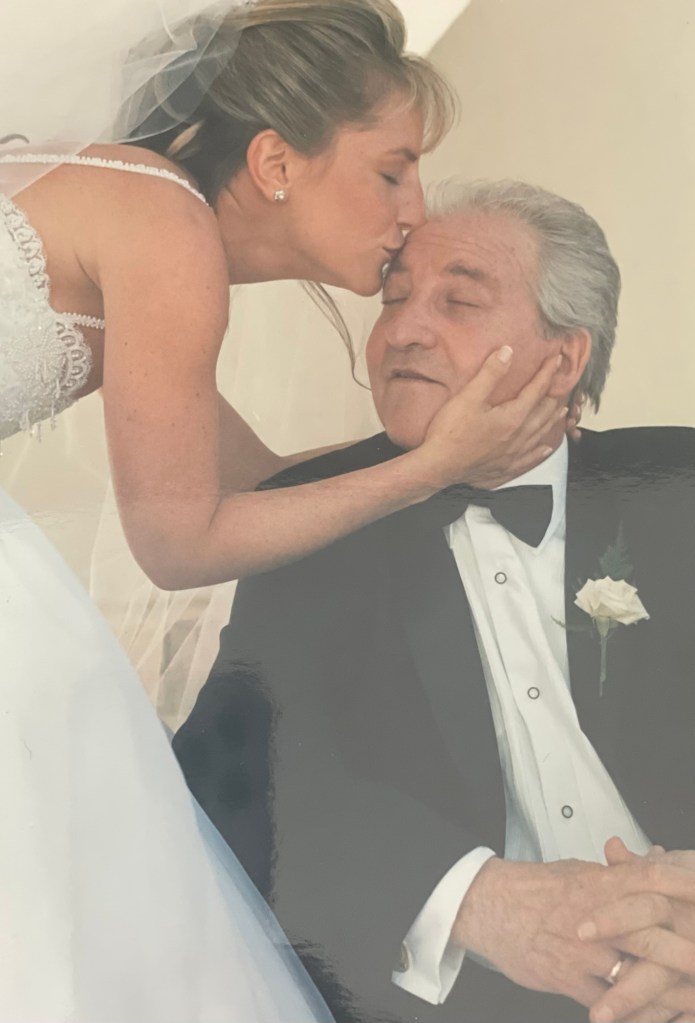
My first musical memory takes me to a twilight hour, a faint smell of whiskey, being held by my father, my arms around his neck, swaying to the sound of the record player. Today, when I hear the raspy, instantly recognisable voice of Eartha Kitt, I am back dancing as ‘Just an Old Fashioned Girl’ and still ‘My Heart Belongs to Daddy’.

The chapters in between my first dance and the birth of my children were filled with so many sounds. There were choirs and musicals, where we moved from Oz to Anatevka as the beat turned around. Dionne and Whitney belted for breakups, Aretha, Madonna and Britney were there to empower and Billy, Boy George, George and Lionel were just a few of the rhythms of the night. I wonder just how much time was spent with my fingers paused and poised on the play and record buttons waiting for a song to add to my tape collection.

Music calmed, comforted, guided and inspired me and somehow with my superpower I managed to file these sound snippets in my mind as neatly as I imagine Apple Music does, but without the use of complex algorithms.

Sound was suspended and my world stopped momentarily when I learnt that my beautiful, ‘perfect” first born daughter was born with ‘imperfect’ hearing. One of the hardest parenting lessons I had to learn then and quickly, was to put aside my own sadness and worry and be ok so that she would be ok. Well intentioned suggestions of solace including “at least she is a girl and her hair will cover her ears” were blatantly ignored as my little girl stepped on to the nursery playground with her aids, her head and her ponytail high.

Thankfully she has heard it all.

She has flown forward, a diligent listener moving to her own internal rhythm with hair longer and lighter.

Musical instruments, tour bands and live concerts are all part of her life and she has the added advantage of streaming sound directly into her ears and switching off to some unpleasant ones.

I have accompanied her to every single hearing test and while I have never been one to stress over academic assessments, I hold my breath as we sit in the sound proof cubicle together.

I turn away from my daughter so as not to distract her and I close my eyes. As my ears strain to hear the sounds that she acknowledges with the click of a button, I can see the near infant who turned to face the drumming teddy and the little girl who placed a marble in a box each time the computer beeped.

Finally, I hear that her audiometry results are stable and each time I hear it, it is like music to my ears.